
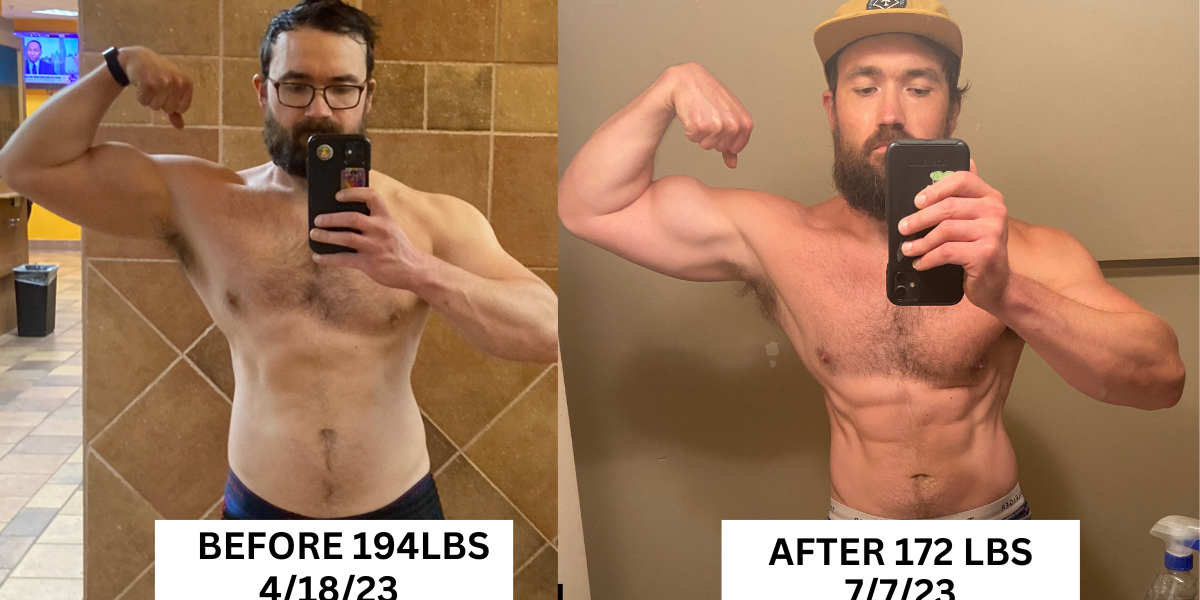
The Ultimate Guide To Fat Loss
If you’ve ever looked up fat loss on the internet you’ve likely been overwhelmed by tons of information. To make matters worse, the information is often conflicting. Unless you’re an expert on the topic, deciphering what is accurate is nearly impossible and can leave you feeling hopeless.
In this article, I’m going to simplify the fat loss process in a way that is easily digestible and scientifically proven. After reading this article, you will have all the necessary tools to start your fat loss journey.
The difference between Weight loss and Fat Loss
Before going further it’s important to make a distinction between weight loss and fat loss. Weight loss refers to a decrease in your overall weight. This decrease comes from a loss of muscle, water, and fat. Fat loss, on the other hand, refers to a drop in weight from a decrease in fat.
If you’re reading this article it’s because you want to lose fat, not muscle. Muscles are important for keeping you strong, increasing your metabolism, and giving your body shape.
Calories are King for Fat Loss
To lose fat, you need to understand the role that calories play. A calorie is a unit of energy that the body can either use immediately for energy or it can be stored for later use. All of the calories that you consume from food/drink are used by your body to keep you alive and provide you with energy.
The Role of Calorie Balance
Calorie balance, also known as calories in calories out refers to your body’s energy balance. There are 3 energy balance states (positive, negative, and equal). Each of these will determine if you lose weight, gain weight, or maintain your current weight
1.Positive energy balance– also known as a calorie surplus. Your body only needs a certain amount of calories to function. If you consistently eat more calories than your body needs, the extra calories will be stored. If you’re an active person who lifts weights regularly a lot of those extra calories will be stored as muscle and some will be stored as fat. If you’re mostly sedentary, almost all of those extra calories will be stored as body fat.If you eat more calories than you burn for an extended period of time, YOU WILL GAIN WEIGHT, there is no exception to this.
2.Negative energy balance– also known as a calorie deficit. When you consume fewer calories than your body needs, your body is forced to use any stored calories in your muscles and fat for energy. Consistently, eating less than you burn WILL CAUSE WEIGHT LOSS, there is no exception to this rule. Later in this article, you will learn how to hold onto any existing muscle you currently have so that you just lose fat when you are in a deficit.
3.Equal energy balance– also known as maintenance. When the amount of calories you consume, equals the amount of calories you burn you will not gain or lose weight. Just like with the calorie surplus and calorie deficit, there is no exception to this rule.
If you only take one thing away from this article it should be that you must be in a calorie deficit to lose fat. This is not negotiable. Every person in the history of the world who has ever lost fat has done it with a calorie deficit, either intentionally or unintentionally.
The Impact of Macro Nutrient on Fat Loss
There are three macronutrients, proteins, carbs, and fats. Technically alcohol is also a macronutrient but in this article, the focus will be on the first three. Each macronutrient is composed of calories.
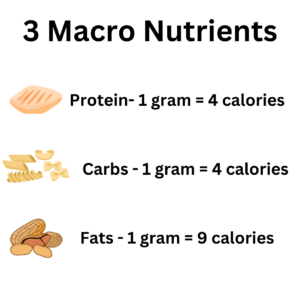
The macro hierarchy for fat loss
Every Macro is important and plays a different role but when it comes to fat loss, there is a hierarchy…
Protein: the most important macro for fat loss
Protein is composed of 20 amino acids. 11 of these are essential, meaning they can’t be produced by your body and must be consumed through food. Protein is the most important for fat loss for two reasons. The first is that consuming enough protein while in a deficit will help you hold on to muscle so that you just lose fat.
Remember, the goal of fat loss is to lose fat, not muscle. To make sure you are getting enough protein try to consume anywhere from .8 – 1 gram per lb of body weight. Here is how that would look…
125lb person – 100-125 grams of protein
135lb person- 110-135 grams of protein
150lb person – 120-150 grams of protein
175lb person- 140 – 175 grams of protein
The second major benefit of protein is that it is the most satiating/filling macronutrient. If you don’t believe me, try to eat as many skinless chicken breasts as possible. I guarantee you won’t be able to eat more than one or maybe two before being too full to continue. Choosing filling foods is crucial when in a deficit because if you’re constantly hungry you will at some point fall off your diet.
Not all Protein is Created Equal
Not all protein is the same so you need to be mindful that you’re consuming the right ones. For example, both bread and meat have protein but that doesn’t mean they are equal. The protein from bread does not contain all 11 essential amino acids and is therefore considered incomplete whereas meat does contain all 11 and is considered complete.
When choosing your proteins you should prioritize complete sources. Some examples of these are lean meats, fat-free Greek yogurt, and whey/casein protein powders. Soy is a good complete protein option if you’re vegan.
Carbs: The second most important macro for Fat Loss
Carbs are important because they provide you the energy needed to perform hard workouts and they help your body recover from those workouts. Resistance training is very important for fat loss. Not so much because you burn a ton of calories lifting weights (you really don’t) but because lifting weights will ensure that you hold onto your muscles when you’re in a deficit so that you just lose fat.
On top of aiding with workouts and recovery, carbs are also anti-catabolic, meaning they help prevent muscle loss. If you eat enough protein, and regularly lift weights, your chances of losing muscle when in a calorie deficit are greatly reduced.
Don’t carbs make you fat?
It may be surprising to hear that carbs are beneficial for fat loss given the fact that they are often demonized in the media. If you mention you’re trying to lose fat to someone, you will most likely hear that you need to cut out carbs. This is not a good idea for all of the reasons listed above. Remember that calories are still king. So as long as you’re in a calorie deficit, you can eat carbs and you will lose weight. But remember, if you want to lose just fat you need to eat enough protein and lift weights.
Fats: The third most important macro for Fat Loss
Fats are the third most important macro for fat loss but just because they are third does not mean they don’t matter. You literally need fats to survive. Fats are important for ensuring optimum hormone levels in your body.
You don’t need to eat a lot of fat but there is a minimum amount required for keeping you healthy and your hormone levels in check. You don’t want to eat any less than .3 grams of fat per pound of body weight. So if you weighed 150lbs you would want to get at least 45 grams of fat every day.
Low- carb vs Low-fat diets
Although I’ve ranked carbs as more important than fats, at the end of the day calories are still king. If you’re dieting and calories and protein are equated, low-carb and low-fat diets will lead to the same results.
This was recently demonstrated in a meta-analysis comparing long term weight loss between low carb and low fat and at the end of the study, both groups lost the same amount. Personal preference is important here. The only successful diet is the diet you can stick with. If you prefer to eat low fat go with that and if you prefer to eat low carb that’s fine too.
Food Composition
At the end of the day, if you want to lose fat you just have to eat less than you burn. You could literally do this with donuts and ice cream but that would be a pretty bad idea because even though you would lose weight doing that, you would lose a lot of muscle from a lack of protein and you would likely feel bad because you would be deficient in important micronutrients.
The Role of Micronutrients
Micronutrients are composed of key vitamins, minerals, and phytochemicals and are essential for humans. All foods have micronutrients but some have more than others. Lean meats, dairy, whole grains, fruits, and veggies are all great sources of micronutrients. Generally speaking, ultra processed foods like donuts and ice cream have very few micronutrients. That doesn’t mean these foods are “bad” but it does mean they should not make up the bulk of your diet.
Food Choices can make or break a diet
Hunger can be a major pitfall when dieting. Some hunger is normal but you should not be starving. Your food choices will make a big impact in this department. To increase your chances of success, you should prioritize lean protein and high volume/low calorie dense food because these will be the most filling options.
Best Protein Options for Fat Loss
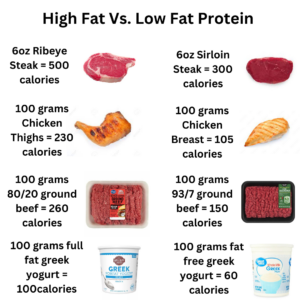
Protein is very filling and thus hard to overeat, making it an excellent choice for fat loss. While all meat/dairy products are high in protein, some are also high in fat and should be avoided, not because they are “bad” but because they are higher in calories. Check out the calorie differences in the different types of protein below…
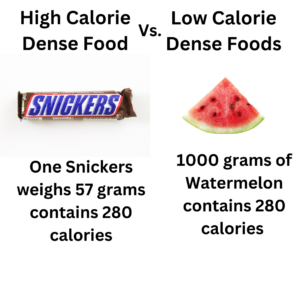
High Volume/Low Calorie Dense Foods
Low volume/Calorie dense foods are small in size but contain large amounts of calories. Candy bars, Ice Cream, Donuts and Pizza are all calorie dense foods.
Even though a candy bar is not a lot of food, it contains a lot of calories. At the other end of the spectrum are high volume/low calorie dense foods. These are foods that contain very few calories, even in large portions. Fruits and veggies fall into this category. You will want to prioritize high volume/ low calorie dense foods as they are difficult to over consume.
Prioritizing low calorie foods when you’re in a deficit is helpful from a psychological perspective as well. If you mainly eat high calorie dense foods, your portion sizes will need to be tiny, which can be demotivating. If you go with high volume/low calorie foods, your portion sizes will be significantly bigger. High volume foods also tend to be healthier because they are packed with fiber and micronutrients.
 Tracking your food is the key to success
To lose fat, you need to know how much food you’re consuming. The only way to do this is by tracking your food. There are two methods you can use to track your food. The first is to measure it by volume using measuring cups and the second way is to measure it by weight using a food scale.
The most accurate and reliable way to track is with a food scale. When using measuring cups it’s too easy to underestimate your portion size. Peanut butter is the best example of this. A serving size of peanut butter is 1 TBSP or 16 grams, yet most people can fit as much as 45 grams of peanut butter in a TBSP. This makes a really big difference. 16 grams of peanut butter contains 94 calories while 45 grams of peanut butter contains 265 calories!
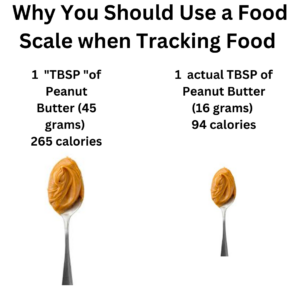
Using a scale to weigh your food sounds tedious, but it will take an extra 2 minutes at most to do. It’s also a great teaching tool to learn about different portion sizes. You won’t always need to weigh your food out but in the beginning stages when you’re learning about portion control, it can be a great tool.
Calculating your calorie needs for fat loss
The easiest way to create a deficit is to first figure out your maintenance calories. Remember, maintenance calories refer to how many calories you need to maintain your current body weight. To find this number you will need to track ALL of your food/drink intake for at least a couple of weeks. Average out each day’s calorie intake for those two weeks and you will have a pretty good idea of how many calories it takes to maintain your weight.
Creating the calorie deficit
Once you’ve calculated your maintenance calories you will need to make a reduction to create a deficit. A simple way to do this is to subtract 250-500 calories from your maintenance calories. For example, if you’ve been maintaining your current weight by eating about 2500 calories a day you would want to eat anywhere from 2000- 2250 calories to be in a deficit. This is the most basic way to create a deficit.
Calculating your fat loss macros
Once you have figured out how many calories you need to be in a deficit, it’s time to find your macro ratios. The amount of macros you need will be dependent on your body weight. For the sake of example let’s say you weigh 150lbs and you have calculated that you need 2000 calories a day to be in a deficit.
Calculating your protein needs
The first and most important macro to figure out is protein. Remember, most people should aim for .8-1 gram per lb of protein. So if you weigh 150lbs you would want anywhere from 120 grams – 150 grams. In this example, we will set your protein intake at 150 grams a day.
Calculating your fat needs
The second macro you need to calculate is your fats. You want to eat at the very least, .3 grams of fat per lb of body weight. So for a 150lb person that would be 45 grams of fat. Since that is the very low end of the spectrum it’s a good idea to go a bit above that number so let’s set fats at 60 grams.
Calculating your carb needs
Ok, so right now we have our protein goal set to 150 grams, and our fats at 60 grams. It’s now time to do a little math to figure out your carbs. Remember that 1 gram of protein contains 4 calories and 1 gram of fat contains 9 calories. To figure out your carbs, multiply your protein goal by 4, then multiply your fats goal by 9, and then add those two numbers together…
Protein- 150 x 4 = 600 calories
Fats- 60 x 9 = 540 calories
600 + 540 = 1140 calories
Your daily calorie intake from both your proteins and fats is 1140 calories. When you subtract that number from your total daily calorie requirement which is 2000, you are left with 860 calories.
2000 (total daily calorie requirements) – 1140 (calories from Protein and fat) = 860 calories
You now have 860 calories that can be dedicated to carbs. Since 1 gram of carb is 4 calories, divide 860 by 4.
860 / 4 = 215 grams of carbs. So your daily carb goal is now 215 grams.
So your daily macro goals will be…
Protein – 150 grams
Fats – 60 grams
Carbs- 215 grams
How to read Nutrition Labels
Besides fruits and vegetables, any food you buy in the grocery store will have a food label on the back. The food label will list all of the nutritional information about the product including the serving size, the calories per serving, and the macros per serving. Here is an example of the nutrition label on the back of a jar of peanut butter…
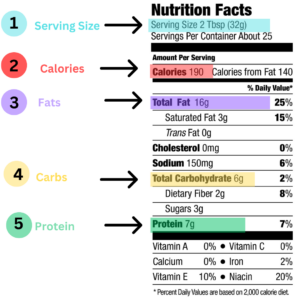
So for example, if you had two servings of peanut butter, that would equate to 14 grams of protein, 12 grams of carbs, and 32 grams of fat.
How to measure progress
The easiest way to measure progress is to monitor your weight. The scale will be a useful (but not the only) tool in this process. Every morning weigh yourself, on an empty stomach, after using the bathroom.
After 7 days of weigh-ins, take the average of those numbers. Do this again the following week. If your weight is trending down for two to three weeks and you’re lifting weights and eating enough protein, you’re in a deficit and are losing fat.
If after 2-3 weeks you have not lost any weight you have two options. The first is to make another reduction in calories and the second is to take a look at how accurate you’ve been with your food tracking.
Inaccurate food tracking is almost always the culprit here. It’s common for people to not track things like cooking oils, coffee creamer, and random snacks throughout the day. Those things will really add up! So before you decrease your calories, make sure you’re tracking accurately.
Don’t worry, the scale will fluctuate!
This is important to remember. Fat loss is never linear. Your weight fluctuates constantly and some days it will spike up. When this happens, DO NOT PANIC. Weight spikes are common and are usually caused by the following three reasons…
Reason #1 You ate more carbs than usual
Carbs will not make you fat but they will make you hold onto water. A good example of this is bread and water. If you pour water onto a piece of bread, it will absorb a lot of that water and become soggy and heavier. So if you eat more carbs than you’re used to, a common result will be water retention and an increase on the scale. Since this is not an increase in fat, it’s nothing to worry about.
Reason # 2 You ate food later than you normally do
If you usually have your last meal at 7:00, but for whatever reason you ended up eating at 11:00, you will likely weigh more than usual the next morning. Again, not indicative of fat gain so no big deal.
Reason # 3 You ate more salt than usual
Like carbs, salt can lead to water retention. Oftentimes you will weigh more the day following a meal at a restaurant because restaurants are notorious for using liberal amounts of salt in their meals.
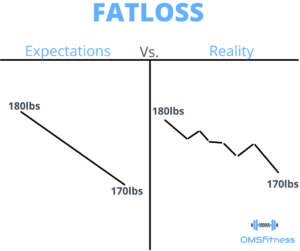
A single weigh-in means nothing, keep the big picture in mind
If possible, try to view each weigh-in as a random data point. By itself, a single piece of data is meaningless, but when looked at over time, it tells a picture. It’s the same thing with the stock market. The market can fluctuate wildly from day to day but over the course of weeks and months it usually will show a more reliable trend.
How long will it take to lose fat?
Most people want instant gratification. This is especially true for fat loss. There is good news and bad news when it comes to rapid fat loss.
The good news is that you can certainly lose fat fast. The bad news is that rapid fat loss, also known as crash dieting, will lead to higher rates of muscle loss. More importantly, crash dieting is not sustainable. Extended periods of extreme caloric restriction will often lead to binge eating episodes which will result in weight rebound. People who crash diet, will more often than not rapidly regain their fat and oftentimes add even more.
Slow is almost always better
If you’ve gotten this far, it’s clear that you not only want to lose fat but you also want to keep it off. For sustainable fat loss, slower is almost always better. Depending on how much you have to lose you should aim to lose .5-1% of your current body weight per week. So if you weigh 150 lbs, a reasonable goal would be to lose anywhere from .75lbs – 1.5lbs per week. The lower end of this range is almost always the best option, especially if you’re new to dieting.
How long should you diet for fat loss?
Being in a calorie deficit is both physiologically and psychologically taxing. For this reason, you can’t stay in a deficit forever. You should not diet for any longer than 12 weeks. Anywhere from 8-12 weeks will be best for most.
If you push it too hard for too long you will start to see some pretty nasty effects. This will negatively impact your hormones, your sleep, your energy levels, your mood, and your sex drive. These things will take a while to correct if you let them get out of control.
What to do after losing fat?
This is the part that most people get wrong. After dieting and losing your desired amount of fat, you’re not quite done. At this time you will need to take a diet break, also known as a maintenance period. Remember, dieting is stressful on the body, so you don’t want to stay in a deficit any longer than you need to.
During this time, you will need to increase your calories so that you’re no longer in a deficit and you just maintain your new weight. When you increase your calories you should expect to add a little bit of weight back, anywhere from 1-3lbs is pretty standard here. This is unavoidable and part of the process. You need to stay in this maintenance period for at least 2/3rds the length of your diet. So if you dieted for 12 weeks, you would need to stay in maintenance for at least 8 weeks.
Don’t skip this maintenance period, SERIOUSLY
Maintenance periods can be challenging, especially if you’ve just lost a lot of fat. It’s natural to want to keep the ball rolling and to continue dieting but THAT IS A BAD IDEA. You have to give your body a break.
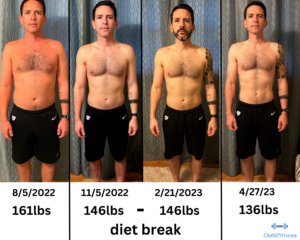
If you still have more fat that you would like to lose, you can start another fat loss diet after your maintenance period. This is exactly what my client Justin did. He dieted for 12 weeks and lost 15lbs but he still wanted to lose a bit more fat. Instead of continuing to diet, I had him take a 3 month diet break to give his body a rest. After completing this maintenance period we started up the diet again and over the next 8 weeks he lost an additional 10lbs. The results speak for themselves…
The Role of Exercise on fat loss
By this point, you’re probably wondering why I have not talked about exercise. This is intentional. When it comes to fat loss, your diet is the most efficient way to get yourself into a deficit. Could you do it through exercise alone and not change your diet? Yes, you could, but it would be miserable because the amount of time it would take would be unmanageable.
So unless you’re running a marathon every day, your diet should be the main area of focus for fat loss. This is not to say that exercise is not important though. You should be regularly doing cardio and lifting weights.
Cardio Vs. Lifting Weights, what’s more important for fat loss?
Cardio and lifting weights are both important for overall health and longevity but in the context of fat loss, resistance training is slightly more important. Remember, that you want to just lose fat, not muscle. Lifting weights, along with eating enough protein, is the best way to ensure that muscle loss does not occur, or is at least minimized. If you just dieted, without lifting weights, you would undoubtedly lose muscle and you would not be happy with the results.
The Power of Walking
Cardio in the form of running, biking, or swimming are all fine options but in my opinion, nothing beats walking. Walking doesn’t require equipment, is very easy on the joints, will burn some calories and most importantly, has been shown to lower your risk of all-cause mortality. Walking should be an everyday part of your routine and having a daily step goal can be helpful.
Why You Should by counting your steps
When you’re in a deficit, your body will do everything in its power to conserve energy. One way your body does this is by moving less. This reduction in movement is usually subconscious. Oftentimes, this lack of movement can slow your rate of loss or even stall it out. It’s important to be proactive about keeping up with movement and having a daily step goal can be a great way to do this. Anywhere from 8-10k steps a day is a good goal for most.
Fat Loss Diets are NOT permanent
This is important. Many people are scared to start a fat loss program because they are worried they will have to be dieting for the rest of their lives. This is not true. Fat loss phases are called phases for a reason. They should only be done for set periods of time. No one should live their lives constantly dieting.
General Tips for a Successful Fat Loss Phase
Get comfortable with being uncomfortable
Losing fat is hard work and you will likely be uncomfortable at times. You will sometimes feel hungry and you may need to make some sacrifices like not ordering exactly what you want every time you go out to eat. When you start to feel uncomfortable, you need to remind yourself that this is temporary and will all pay off in a few months.
Tradeoffs will need to be made
This one can be challenging, but to lose fat you have to be ok with making some sacrifices. You will need to TEMPORARILY give up some things to achieve your goals. For example, if you’re used to going out for Pizza three times a week, you might need to settle for going out for pizza once every two weeks. This trade off might be annoying but it’s what will get you to where you want to be. Before embarking on a fat loss journey, make sure that you’re ok with this. Luckily, diets are only temporary and you will not need to make tradeoffs forever.
Meal Prepping is the Key to Success
Meal prep is a must. That cheesy saying “fail to plan then plan to fail” is true with fat loss. If you don’t already have something made then the chances of you just snacking on chips or going to get fast food increases drastically. Spending one or two nights a week batch cooking a bunch of lean protein, carbs, and veggies will go a long way.
Consistency is everything
If you want to succeed, you need to be consistent. Eating perfectly during the week means nothing if you go crazy every weekend. That weekend will wipe out your deficit for the week and may even put you into a surplus. This is extremely common and a large reason people don’t make substantial progress. Meal prepping will help prevent this.
Ask yourself why you want to lose fat
Have a firm understanding of why you want to lose before you begin. Losing fat takes a lot of hard work and effort. You have to really want it to be successful and you have to be prepared to work for it. It’s not easy, but it’s extremely rewarding.
Patience is a must for fat loss
Be patient. This is probably the hardest thing for people. You’ve got to understand that this is a process and you will mess up at first, a lot. That is ok. As long as you get back to it you will reach your goals. If you think you’re going to be perfect (or ever) from the start you will be seriously disappointed.
Final Thoughts
Hopefully, this guide was helpful and you now have all the necessary tools to start your own fat loss journey. If you have any questions, please let me know below!
Also, if you need some guidance with all of this and would like to take the guesswork out of things, please message me to learn more about my personal training/nutrition packages.
As a coach, my entire goal is to do all of the hard thinking for you. All you will need to do is follow the plan and you will see amazing results!