
Scale fluctuations suck. They are demoralizing and can put you in a major funk. In this article I’m going to discuss everything you need to know about the scale, daily fluctuations and why you should not let them ruin your day.
Weight Loss vs. Fat Loss
Before going further its important to understand the difference between weight and fat. Weight refers to a combination of your bones, organ, muscles and water. Fat on the other hand, is just fat. In this article when I use the word “weight”, I mean weight and when I say “fat” I mean fat. More often then not, scale fluctuations are the product of weight fluctuations, not fat fluctuations.
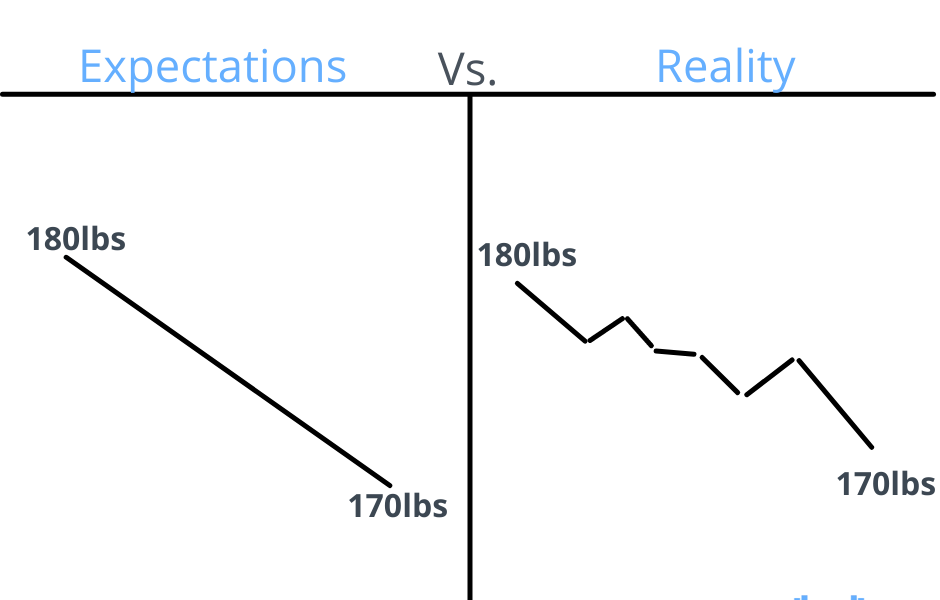
Fat loss will never be linear.
The scale can fluctuate wildly from day to day. It’s not abnormal for your weight to fluctuate from 2lbs to as much as 10lbs in a day! These fluctuations can usually be explained by outside factors that have nothing to do with actual fat gain.
7 most common causes of fluctuations and what they actually mean
- You had a tough workout the day before.
After a taxing resistance training session your muscles will hold on to water in an effort to aid in recovery. This increased water storage will result in your weight spiking for the next day or two; this is temporary and is not an indication that you have gained fat.[1]
- You ate more carbs than usual the day before.
Carbs soak up water, so if you eat more carbs than usual one day, your body is going to hold on to more water. This is temporary and not an indicator of an increase in fat.
- You need to poop.
If you’re backed up, you will weigh more because you have more mass sitting in your body. Once you go to the bathroom your weight will settle.
- You ate more salt than usual the day before.
Just like carbs, salt attracts water. If you eat more salt than normal one day, your weight will reflect that. Often times, people will weigh more the day after you go out to eat at a restaurant because restaurants are notorious for using copious amounts of salt.
- Your stress levels are high.
High stress leads to water retention. Ironically, scale fluctuations often cause people to stress out, which in turn leads to more water retention and more fluctuations! It’s a nasty and frustrating cycle.
- You’re menstruating.
When you menstruate you hold on to water, which causes a temporary weight spike. It is not fat, just water that will go away.
- You weighed yourself later than usual.
Your body weight goes up throughout the day so if you usually weigh yourself at 8am but you weigh yourself at 12pm you’re likely going to weigh more.
Now that we know what causes these fluctuations, how do we deal with them?
Some people simply can’t handle them and that’s ok! For those people, the stress the scale causes is just not worth it and in that case you should rely on other equally helpful measures of progress, which we will discuss later.
However, if you’re the type of person who benefits from daily weigh-ins, or at least multiple weight-ins a week, it is important to adhere to the following guidelines:
- Weigh yourself at the same time after waking up each day
- Weigh yourself in your underwear or naked
- Weigh yourself after you use the bathroom
It is important to note that weigh-ins serve one purpose…data collection. Every time you step on the scale, you are collecting a random data point. By themselves, each data point means nothing, but when combined after a few weeks/months a clearer picture starts to arise.
What does the data tell us?
Since we know that a single weigh-in is unreliable due to random scale fluctuations, we need to look at weekly averages to see what’s going on. If your weekly weight averages are trending down (and your goal is to lose) then you’re on the right track. Here is what that might look like…
Week 1 – 175lbs weekly average
Week 2 – 174lbs weekly average
Week 3 – 173.5lbs weekly average
Week 4 – 172.5bs weekly average
As you can see, the averages are trending down at a reasonable pace.
What if my averages are not trending down?
Your averages might not trend down every week but if they are the same or even higher for 2-3 weeks it means that you are getting something wrong with your nutrition and are not actually in a calorie deficit. Remember, in order to lose fat you need to be in a calorie deficit, meaning you consume less food/energy than you burn.
Usually, when people see that their averages are not trending down they immediately lower their calories. This makes sense on paper but is usually not the right call. More often than not, people who think they are in a calorie deficit are actually not. This is because people often struggle with tracking their food intake and usually underestimate how much they’ve actually eaten.[2] Unintentionally under-tracking food is easy to do, especially if you don’t weigh your food. Also, things like cooking oil, coffee creamers and random snacks throughout the day get overlooked.
If you’re not losing and you think you’re in a deficit, spend a week diligently tracking your food intake (weighing everything if you can) and see if you’ve been missing anything. This may sound tedious but if you really want to lose then this is what it’s going to take.
What if I know I’ve been tracking accurately, it’s been 3 weeks, and I’m still not losing?
If this is the case then you will need to lower your calories or increase your physical activity. It’s best practice to just make one change at a time if possible. Try lowering calories for a few weeks and if you’re still not losing at a reasonable rate then add in some cardio. A few caveats…if you are already have a relatively small body frame (130lbs or lighter) and are already eating pretty low calories then add in some cardio. On the flip side, if you have more fat to lose then lower your calories first.
Other measures of progress
The scale CAN be a usual tool for gathering data and tracking progress but it is by no means the only tool. Here’s some other metrics to rely on:
- How your clothes fit – if your pants are all of a sudden too big then you’ve lost fat!
- Body measurements – taking measurements every few weeks is a great way to assess progress.
- Progress pictures – when you start a fat loss journey, it is always a good idea to take pictures of yourself from the front, back and the side. Take pictures every month and see if you notice any changes.
Whether you choose to use the scale or not, remember that fat loss takes time, consistency, dedication and most importantly patience. Be patient with the process and patient with yourself!
[1] https://pubmed.ncbi.nlm.nih.gov/24471859/